- svetovanje.izobrazevanje.ms@gmail.com
If you had €1,000 in the bank in 2000 and left it there without interest until 2025, then inflation has caused a real decline in the value of your money - this means that you can buy much less with that amount today than you could 24 years ago.
How much is the drop in purchasing power?
Inflation 2000–2025 in Slovenia: ≈119.5%
This means:
€1,000 in 2000 = approximately €2,195 today
But if you still only had €1,000, then you only realistically have around 45% of that purchasing power.
TIPS:
1. Don't let money "sit" in an interest-free account
Savings accounts or time deposits often don't even cover inflation. The money in a transaction account decreases in real terms every month.
✅ Rather move it into investments that at least maintain its value.
🪙 2. Diversify into different investments
Divide your money among several types of investments, such as:
📈 Stocks (ETFs or individual stocks)
🏠 Real estate (including real estate investment trusts – REITs)
⚖️ Bonds
🪙 Gold, silver or other raw materials
🪜 Mutual funds or index funds (e.g. S&P500 ETF)
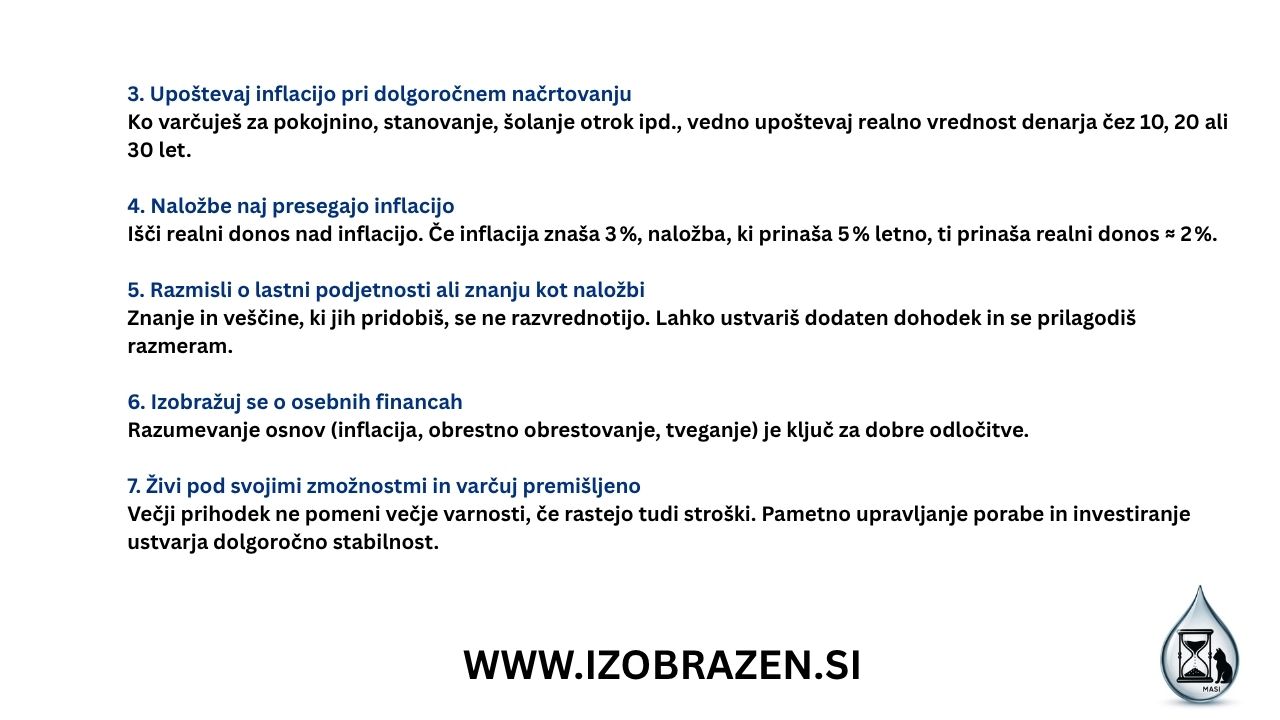
3. Consider inflation in long-term planning
When saving for retirement, housing, children's education, etc., always consider the real value of money in 10, 20, or 30 years.
4. Investments should exceed inflation
Look for a real return above inflation. If inflation is 3%, an investment that yields 5% annually gives you a real return of ≈ 2%.
5. Consider your own entrepreneurship or knowledge as an investment
The knowledge and skills you gain are not devalued. You can generate additional income and adapt to the situation.
6. Educate yourself about personal finances
Understanding the basics (inflation, compound interest, risk) is the key to making good decisions.
7. Live within your means and save wisely
Higher income does not mean greater security if costs also increase. Smart management of spending and investiranje ustvarja dolgoročno stabilnost.



Shop
Contact
-
Marijana Simonic
DISORA Society
www.disora.org - svetovanje.izobrazevanje.ms@gmail.com
- Slovenia